Toyota revives Scion with a 25-mph kei truck built in Indiana
Scion returns in 2027 as an experimental mobility brand, and its first product is a low-speed kei truck aimed at farms, campuses and municipal fleets rather than everyday buyers.
Key takeaways
- Scion returns as an experimental mobility brand, with its first vehicle set for production in the second half of 2027.
- The KEI-01 is a 660cc kei truck capped at 25 mph under federal Low-Speed Vehicle rules.
- Toyota is investing $34 million in its Princeton, Indiana plant and adding about 50 jobs for local assembly.
- Initial sales target fleets such as farms, campuses and municipalities, with consumer retail only a possibility later.
In this article
A badge returns with a new job
Toyota is bringing back the Scion name, but not as the youth-focused hatchback brand it was before it was discontinued in 2016. According to The Verge, the revived label, styled Scion by Toyota, is being framed as an experimental mobility incubator for ideas that do not fit neatly into Toyota's existing lineup, such as utility work, outdoor recreation and customization.
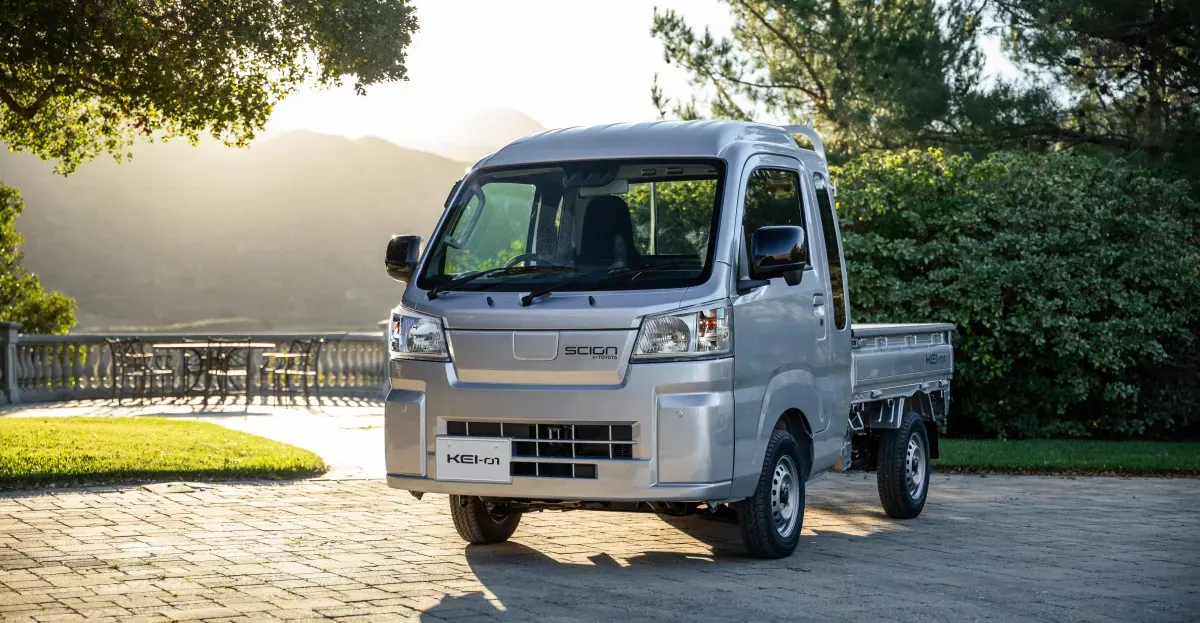
The first vehicle under the badge is the KEI-01, a small truck built to Japanese kei-car proportions and assembled in the United States. Toyota plans to start production in the second half of 2027, with the vehicle sold first to fleets rather than to individual shoppers.
Small footprint, modest power
The KEI-01 uses a 660cc three-cylinder gasoline engine matched to a continuously variable transmission. The Verge notes it will not be quick, but the setup is intended to provide enough power for stop-and-go driving while sipping fuel.
Its main advantage is size. At roughly 11 feet long and under 5 feet wide, the truck takes up about half the footprint of a full-size pickup, which Toyota says lets it navigate tight alleys, barn aisles, garden gates and busy campus paths. An on-demand four-wheel-drive system with a push-button locking mode is included for muddy fields, gravel paths and wet conditions.
The bed has three sides that fold flat, so cargo can be loaded without reaching over high metal walls. Toyota rates the payload at up to 600 pounds, and the truck can tow small utility trailers or mowers. The cabin is fully enclosed and comes with heating and air conditioning, reclining seats, extra headroom from an extended roofline and storage behind the seats. The steering wheel sits on the right, as on Japanese utility imports.
Why it is capped at 25 mph
The KEI-01 is certified under federal Low-Speed Vehicle rules, the same category used for golf carts and similar machines. That classification strictly limits its top speed to 25 mph, which shapes where it can realistically be used: worksites, campuses, farms and local delivery routes rather than highways.
Toyota has not disclosed trim options or pricing. The Verge points out that used Japanese kei imports typically sell for between $6,000 and $12,000, and that the KEI-01's interior, heavy on black plastic and short on premium materials, may help keep costs down.
Indiana assembly and a fleet-first rollout
To build the truck in the US, Toyota is investing $34 million in its Princeton, Indiana plant to set up local assembly and add roughly 50 jobs. Production begins in the second half of 2027.
Even then, ordinary drivers will not find one on a dealer lot. Scion by Toyota is launching the KEI-01 as a fleet-focused pilot aimed at corporate campuses, farms, municipalities and local delivery operators, distributed through a select group of existing Toyota dealerships. Toyota says it may consider retail sales later if demand supports it, but the first phase is explicitly an experiment to see how the truck performs in real American use.
Kei trucks are already having a moment
The KEI-01 arrives as small Japanese trucks gain traction in the US. The Verge reports that more than 30,000 used kei trucks have been imported since 2020, at a rate of roughly 7,500 a year, and that President Trump has said he authorized the Department of Transportation to approve their production.
Toyota appears to be the first major automaker testing whether that interest translates into demand for a new, US-built vehicle. The company also showed two concepts alongside the truck: the SxS Concept, with a hybrid turbo setup producing more than 300 horsepower for high-speed off-roading, and the modular BKE Concept, which explores compact personal mobility. Together they suggest the new Scion will chase niche utility and experimental recreation rather than budget hatchbacks.
Sources
Spotted a mistake? See our corrections policy. Read how News by OnDevice works in our editorial policy.
Related news
More Gadgets news
Zelda Notes app makes Ocarina of Time collectible hunt easier
The free companion app in the Nintendo Switch app maps Golden Skulltulas, Pieces of Heart and other collectibles, and tells players what they need to reach them.

EU Digital Fairness Act targets loot boxes and addictive app design
The European Commission has proposed the Digital Fairness Act, a wide-ranging consumer protection package aimed at dark patterns, addictive features, gambling-like mechanics for minors and influencer marketing. Gaming and social platforms warn the rules go too far.

Nima Momeni sentenced to 16 years to life for killing Bob Lee
A San Francisco judge sentenced tech consultant Nima Momeni to 16 years to life for the 2023 murder of Cash App founder Bob Lee. His lawyers plan to appeal.
Sharge's Pixel 140W GaN charger drops to about $70 in early deals
The compact charger with a built-in wattage display is discounted by roughly $24 at Amazon and Sharge, with smaller cuts on the 67W and 100W versions.