Google researcher uses 48 AI agents to flag possible unmapped Maya site in Mexico
A Google researcher says a team of AI agents scoured NASA LiDAR data and surfaced a structure not yet described in scientific literature. Mexico's national archaeology institute is now investigating, but the site's identity is unconfirmed.
Key takeaways
- A Google researcher says 48 AI agents scanned NASA LiDAR data and flagged a possible structure not yet in scientific literature.
- The agents also identified Mexico's INAH and drafted a Spanish-language email about the find, with a reply arriving within 72 hours.
- INAH experts are investigating, and the site has not been confirmed as an ancient Maya site.
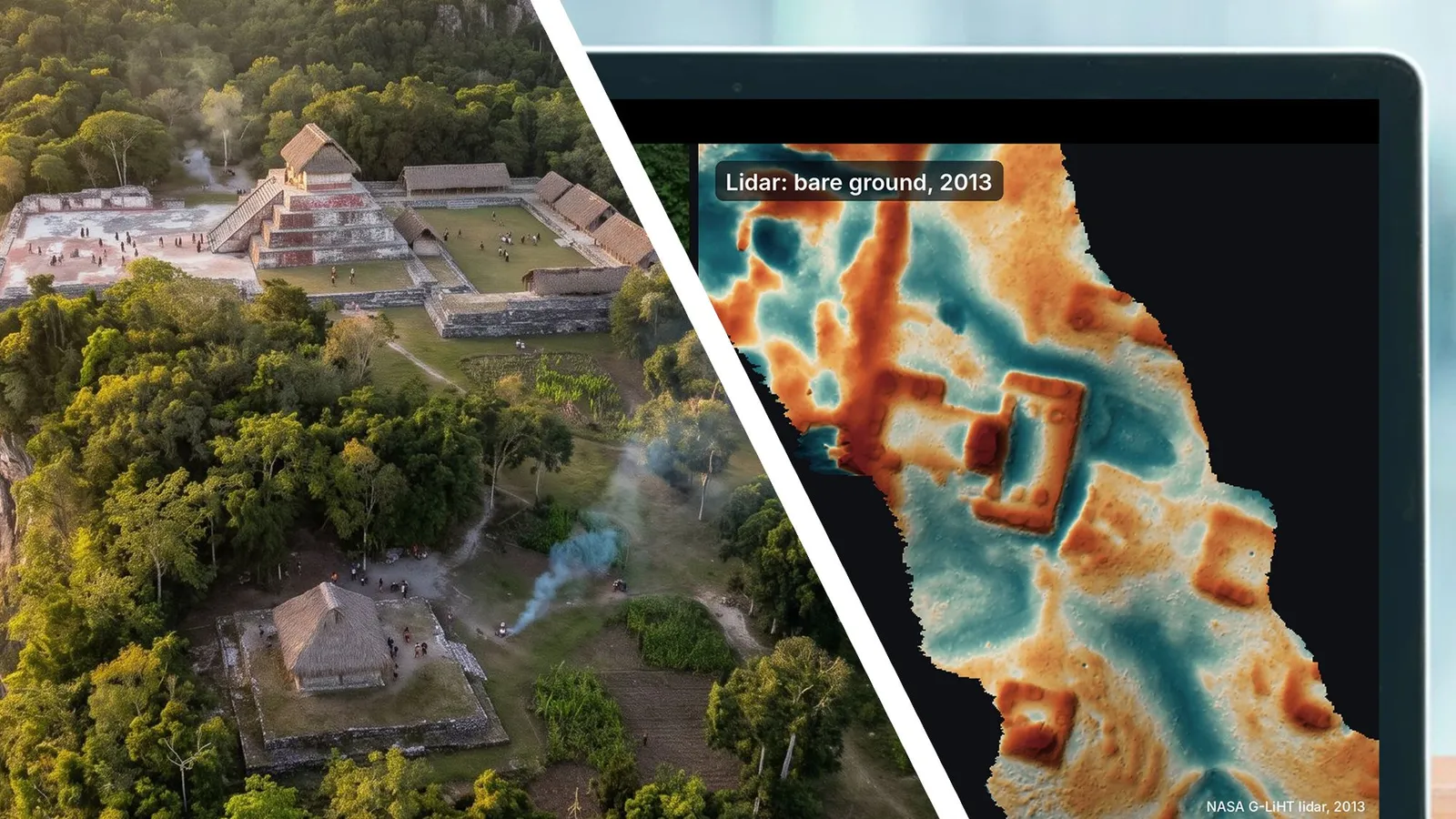
- The researcher used Gemini to generate an illustrative image of the site as it may have looked around 700 CE.
In this article
From a vacation thought to an archaeology lead
A Google researcher says a swarm of AI agents helped him identify what may be an unmapped Maya site in Mexico, according to TechRadar. Pietro Miotti described the project as starting from a random thought while on vacation, in which he wondered whether AI agents could be set loose on LiDAR datasets.
LiDAR, or Light Detection and Ranging, uses laser pulses to map terrain and can reveal shapes hidden beneath cloud cover or forest canopy, including features that are hard for archaeologists to reach on foot. Miotti's experiment suggests such data can be screened at speed by software agents before experts ever visit a site.
How the agent search worked
Miotti assigned 48 agents drawn from different AI apps to comb through a NASA database of LiDAR information collected across Peru, TechRadar reports. The agents returned several hits on structures that could be buildings, and a second pass narrowed the search to one particular site that has not yet appeared in scientific literature.

The agents did more than scan. According to TechRadar, they identified Mexico's National Institute of Anthropology and History, known as INAH, as the right body to contact, and then drafted an email in Spanish describing the find and its location on the map. The whole sequence, from the initial idea to a reply from INAH, took less than 72 hours, Miotti said in a post cited by TechRadar.
What is confirmed and what is not
The key caveat is that the site has not been confirmed as an ancient Maya site. TechRadar reports that INAH experts are investigating further, and that the location is a promising lead rather than a verified discovery. Readers should treat the Maya identification as a claim under review, not an established fact.
What is documented is the workflow: a researcher used commercial AI agents to triage public LiDAR data, then handed a candidate location to the relevant national authority. The archaeological conclusion will depend on fieldwork and expert assessment by INAH.
A wider signal for AI in research
Miotti framed the result as evidence of a broader shift, telling TechRadar that he believes science is on the brink of a revolution across disciplines, not just coding, physics and math. He also suggested that the entire planet could be mapped with LiDAR and handed to agents to help find what remains.
He went on to use Gemini to generate an image of how the site might have looked around 700 CE, when the Maya were living there, TechRadar reports. That image is an illustration, not evidence, and should be read alongside the LiDAR scan rather than as a reconstruction of a confirmed site.
Why it matters
The story illustrates how AI agents are being used to spot patterns in very large datasets, a task they are well suited to. It also shows a practical division of labour: machines flag candidates at scale, while national heritage bodies such as INAH decide what is real and what happens next.
For readers, the takeaway is cautious optimism. The speed is notable, but the scientific value will be settled by experts on the ground, not by the agents that raised the flag.
Sources
Spotted a mistake? See our corrections policy. Read how News by OnDevice works in our editorial policy.
Related news
More Gadgets news
Chinese team sends 64 Tbps over hollow-core fiber across 626 miles
Researchers from China Telecom, YOFC and ZTE demonstrated two-way 64 Tbps transmission over 1,007 km of hollow-core fiber, with 30% lower latency than previous trials of the same type.

BYD unveils solar-powered EV charging station with robotic arms
Chinese automaker BYD has demonstrated a charging site that combines ultra‑fast Flash Charging, robotic arms and a solar‑storage system, allowing drivers to receive a 10 to 70 percent charge in five minutes without leaving their car.

The Curse of Oak Island season 14 returns to History: how to watch
Season 14 of The Curse of Oak Island premiered on History on November 10, 2026, with the Lagina brothers still searching for treasure. Streaming options vary by country, and UK viewers may have to wait until early 2027.

MovieShelf uses LED strips to light up the Blu-ray you want
A Reddit user built a touchscreen library for a physical Blu-ray collection that lights up the exact shelf spot of the chosen disc, and pairs with a separate app that picks the night's film.