Five Android Auto navigation apps to try instead of Google Maps
Engadget lists Waze, HERE WeGo, TomTom, MapQuest and Magic Earth as Android Auto alternatives. They differ on offline maps, privacy and price.

Key takeaways
- Engadget names Waze, HERE WeGo, TomTom, MapQuest and Magic Earth as Android Auto alternatives to Google Maps.
- HERE WeGo and Magic Earth both offer downloadable offline maps; Waze does not.
- MapQuest gained Android Auto support in 2026 and covers only the United States and Canada.
- Magic Earth's Android Auto use needs a subscription costing $21.19 a year.
In this article
What the roundup covers
According to Engadget, published on 28 November 2026, Google Maps is not the only navigation option for drivers who use Android Auto. Android Auto is Google's system for showing phone apps on a car's built-in screen. The publisher lists five alternatives: Waze, HERE WeGo, TomTom, MapQuest and Magic Earth.
Engadget says each one looks different and brings its own strengths. Some focus on privacy, others on offline maps or a cleaner screen. The common thread is that all five work with Android Auto for turn-by-turn directions, which means spoken or on-screen prompts at each turn.
Community reports and voice features in Waze
Waze is built on reports from other drivers, according to Engadget. Those reports cover accidents, speed traps, police presence, closed roads and live traffic jams. The app now uses Gemini-powered Conversational Reporting, so a driver can describe a hazard out loud instead of tapping the screen.
Other features include routes suggested from past trips and a quieter mode that cuts most voice prompts but keeps essential turn alerts. Engadget notes that Waze is owned by Google, so it is not a fix for drivers who want to keep their data away from the company. The app also lacks downloadable offline maps, and its alerts can crowd a small car screen.
Offline maps, parking search and regional limits
HERE WeGo leans on frequently updated maps and broad global coverage rather than crowd reports, Engadget says. It handles turn-by-turn directions on Android Auto and includes many business listings, plus searches for nearby ATMs, pharmacies, fuel stations and restaurants. Maps for many countries can be downloaded, which helps when crossing a border with higher data costs or driving where mobile coverage is patchy.
TomTom, formerly called AmiGO, offers a plain, distraction-free layout and lets drivers report speed traps and closed roads. When a destination is set, the app can look for parking nearby. The TomTom app itself is free, while offline navigation and professional features such as routes based on a vehicle's height and weight sit in the paid TomTom GO Expert, which is aimed at truck drivers.
MapQuest arrived on Android Auto in 2026, according to Engadget. It supports multiple stops, lets drivers pick a start point other than their current location, and can avoid highways and toll roads. Its coverage is limited to the United States and Canada.
Privacy trade-offs and what it costs
Magic Earth uses OpenStreetMap data, carries no advertising and says it does not sell user information to third parties, Engadget reports. It offers offline maps and both 2D and 3D views. The publisher contrasts this with Google Maps, which can store visits and routes when its Timeline feature is switched on.
Cost is where the choice gets practical. Magic Earth now runs a freemium model: basic navigation is free, but offline maps and live traffic need a yearly subscription, and using it with Android Auto costs $21.19 a year. Engadget's excerpt cuts off while describing a trial option, so the trial length is not confirmed in the material available.
Who each option suits
Engadget frames the decision around daily use rather than features alone. It notes that an app can work well in one city and poorly in another, and that a larger crowd of users can improve routing in a crowdsourced app such as Waze.
On that basis, drivers who want live crowd reports may lean towards Waze, while those crossing borders or facing weak signal may prefer HERE WeGo or Magic Earth. Anyone who dislikes a busy car screen may find TomTom's simpler layout easier. Long-time MapQuest users in North America can now keep the app they know. Engadget adds that personal preference matters most, and the article does not name an overall winner.
Sources
Spotted a mistake? See our corrections policy. Read how News by OnDevice works in our editorial policy.
Related news
More Android news
Coros Pace 4 and Amazfit Cheetah 2 Ultra compared on a Spartan course
A 9to5Google writer wore both watches through a 6.8-mile obstacle race. The lighter Coros won on comfort, while the Amazfit collected more detailed data.

Ugreen cuts prices on limited edition Honkai: Star Rail accessories
Ugreen has discounted its Honkai: Star Rail collection, including a retractable 100W cable, a 65W mini USB-C charger and two power banks. The Black Friday reductions bring the Yao Guang-themed range to what Android Central calls record lows.
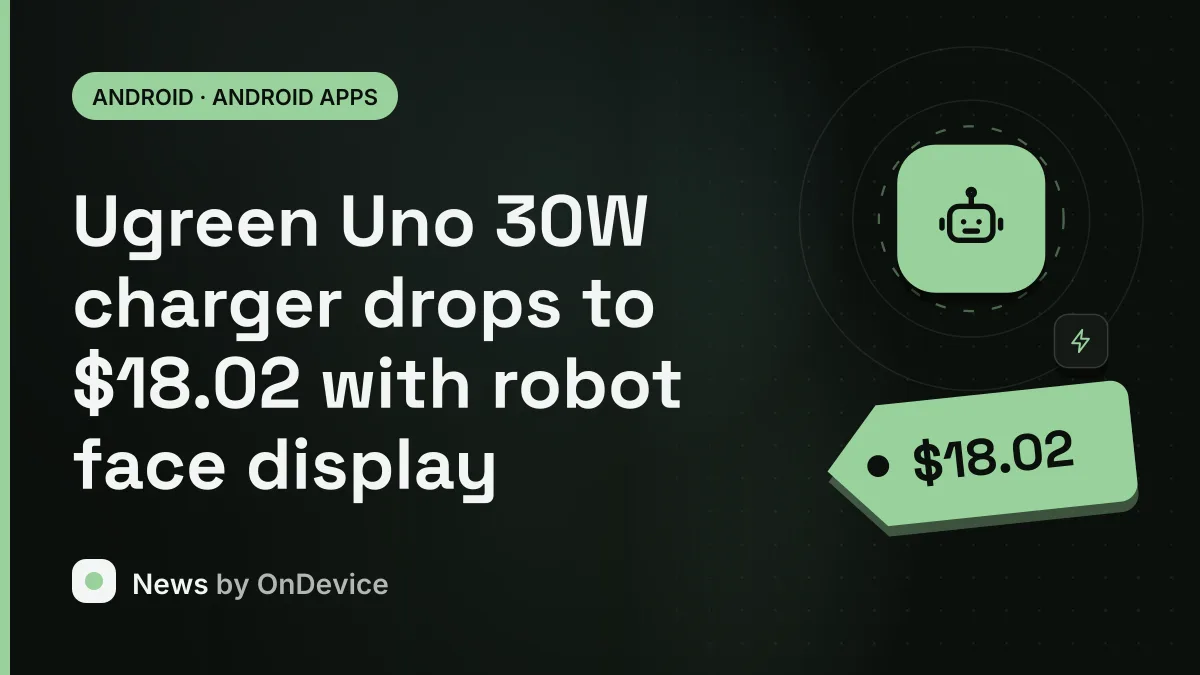
Ugreen Uno 30W charger drops to $18.02 with robot face display
Android Central highlights the Ugreen Uno 30W USB-C Charger, a robot-style plug with an LED face, now listed at $18.02 on Amazon. A matching braided cable is also reduced.
OnePlus Pad Go 2r name leaks before India launch
The alleged OnePlus Pad Go 2r name has leaked, and a tipster suggests a launch date in India. No specifications or price have been revealed.